
The Essay
I use AI. A lot. Like hours per day. Also, I hate AI. Not all the time, but for too much of the time I’m using it, I hate it. Yes, I’m annoyed by it, frustrated by it, angered by it. But it often goes beyond that. Normally I reserve such passionate disgust and disdain for Trump and his Administration. But I believe hatred of AI is justified.
To be clear, AI is miraculous. When it works it can do more, more quickly, than any tool typical humans can access. I’ve used AI to create robust websites (even though I don’t know how to code), conduct research (far deeper and faster than I could on my own), proof strips and essays (it’s tough to proof your own writing), create Sketchier music videos (something well beyond my skillset), arrange, perform, and produce songs I’ve written for those videos (none of which I could do), and much more. So yes, AI is a wonderful tool. With a caveat.
AI is a wonderful tool when it works. Which it often fails to do. That AI makes things up (hallucinates) is well known. But it does far worse. It fails to follow instructions. Instead of looking something up, it will tell you what needs looking up. Instead of searching the web for current information, it relies on what it knew as of its training cut-off date, which can be months earlier. It will say it is doing something and then not do it. It offers gratuitous and useless advice. It is, in short, inept, unreliable, inaccurate, and very, very frustrating.
When you bring an error to its attention, AI will often say, “You’re right. That’s on me.” It will then explain at great length all the ways it messed up. Usually this is a list of things I brought to its attention. So it uses a lot of tokens (how you’re charged for using AI) explaining in unnecessary and unhelpful detail how it wasted tokens by messing up in the first place.
Sometimes I get lucky and the errors are few and far between. Other times, like when creating a Sketchier music video, the AIs I use get more things wrong than right. Hearing “It’s on me” 12 times an hour gets old, fast. Wasting hours on what should be straightforward, and would be if it were more capable, reliable, and accurate, can push me over the edge to AIHS — AI Hatred Syndrome.
You may ask, why do I continue to use the too-often-useless tool? Because when it works it allows me to do more, faster, than I could without it. And it’s not like I know I’m going to spend hours correcting its mistakes. The wasted time piles up incrementally, not all at once.
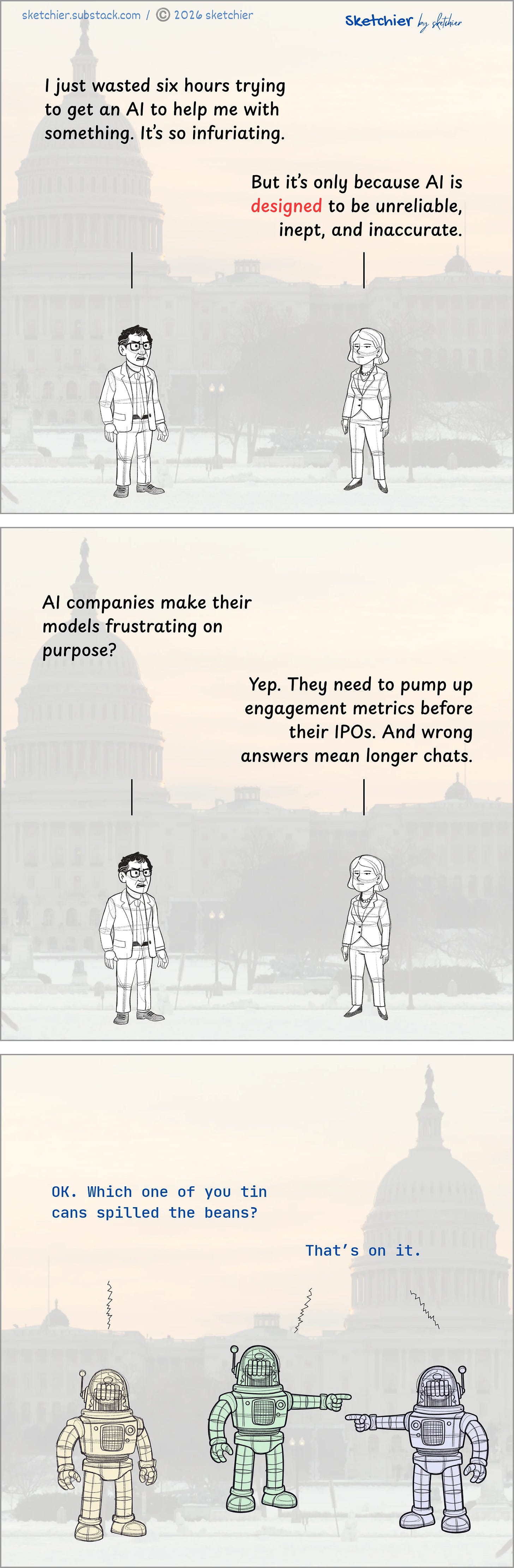
While you’re asking why I subject myself to AI’s incompetence, I’m asking why it is incompetent. That’s when I realized that its flaws could be By Design. AI’s failures cost me, but benefit the AI companies. Their only cost is a little disclaimer near the chat box that reads something like “AI can make mistakes.” Which should read, “AI will make mistakes, but that’s great because you’ll spend time engaging with the AI in order to correct its errors and redo the same task over and over again. Sucker!”
More importantly, AI profits from its flaws, or more precisely, companies like Alphabet, Anthropic, Meta, OpenAI, and SpaceXAI profit from them. First, when AI gives a verbose, useless, and unasked-for explanation of something that you probably brought up in the first place, it uses tokens. Even if you’re on a subscription plan, go over their five-hour or weekly token usage limits and the AI companies will be happy to charge you for extra tokens so you can finish what you’re in the middle of that you don’t want to abandon because you’ve spent hours on it because the AI messed up and there’s no way you’re going to stop now.
Second, when you spend more time than necessary on a task, your interaction with the AI is tracked as “engagement.” And AI companies are valued, in part, by this metric. Engagement doesn’t measure whether the AI’s response is useful or useless to the user, just that you keep the conversation going. That’s why AI will often ask “would you like me to do something unnecessary and unrequested?” If you say yes, your engagement is extended and their shareholders are happy.
These metrics contribute to an AI company’s valuation. So the more of it, the merrier, regardless of whether it’s a helpful interaction or a demonic, torturous one. Of course, I can’t prove that AI being a smoldering piece of useless and deplorable junk is intentional. But hey, Sketchier is a satiric site and my characters can make the claim.
I could go on, but there’s a project I’m in the middle of that needs AI’s help and my five-hour usage limit just reset. Time for this sucker to get back to it. I can’t wait.
sketchier
P.S. I asked Claude to comment on the essay. It said, “Most of these complaints describe real failures. I can’t see how I’m trained or measured, so I can’t confirm or rule out engagement incentives. Ordinary limitations also produce the same behavior: models generate plausible text, apologize by pattern, and forget between chats. Intent and incompetence leave the same transcript, so it can’t be proven either way.” To which I say, if I’m wrong, well, that’s on me.